

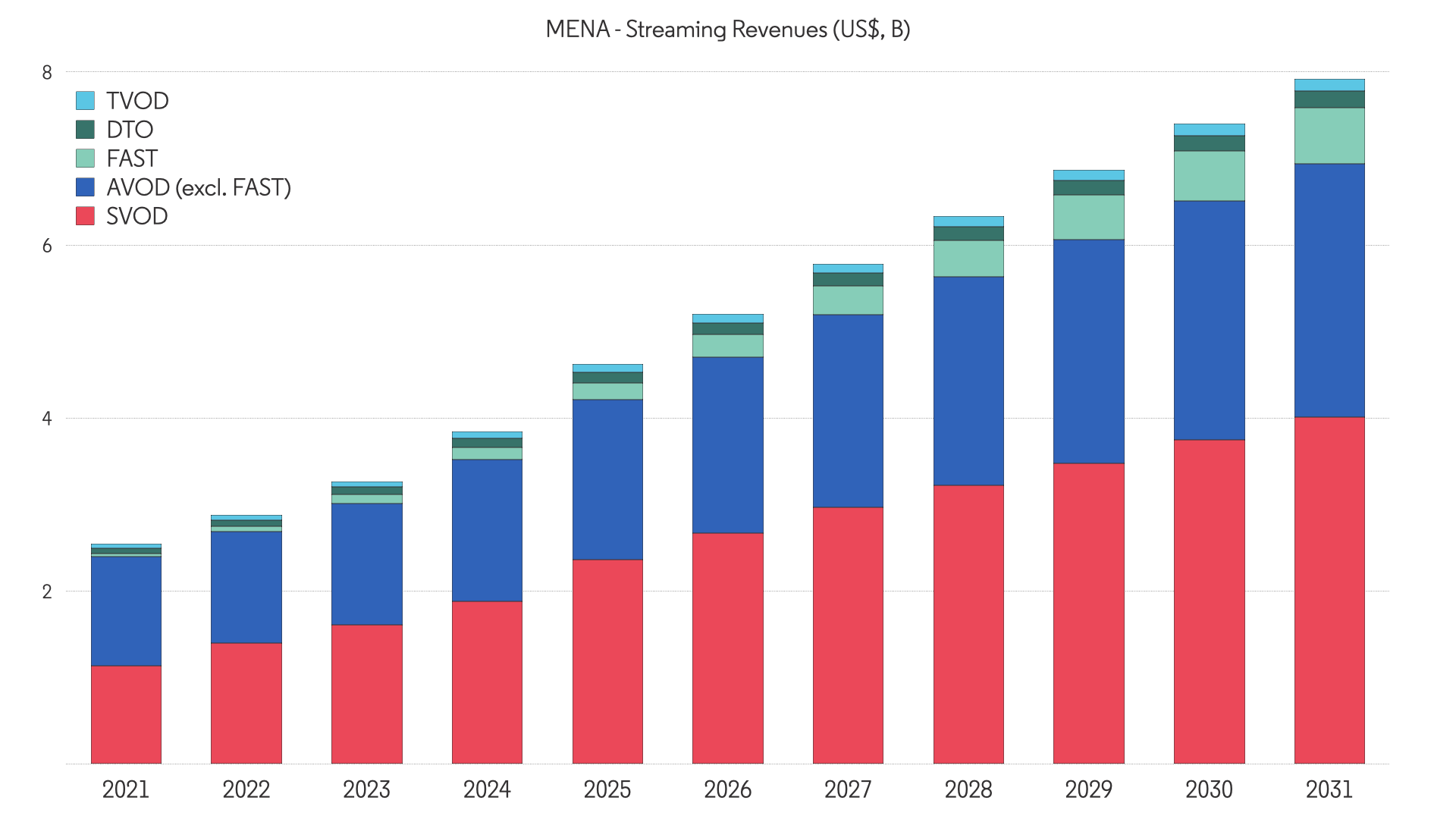
3Vision’s Video Markets Tracker forecasts that the Middle East and North Africa (MENA) streaming market will grow from $5.0B to $7.6B by 2031. But that headline hides a split. The Gulf is rich, stacked and led by a regional champion. North Africa is vast, under-penetrated and still working out how to make money. Same region. Two very different games.
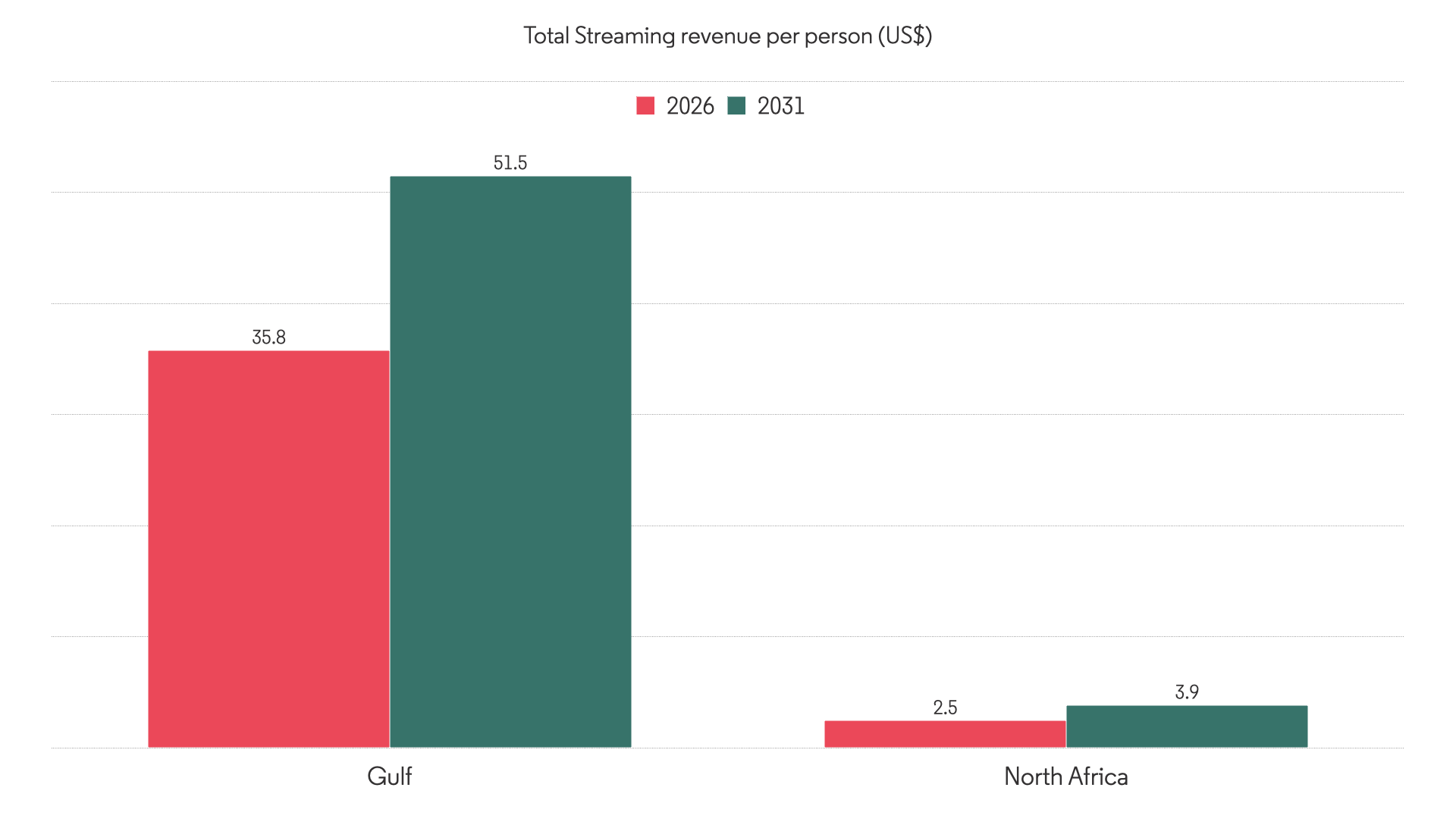
MENA streaming revenue per capita: a 14x gap
In the six Gulf Cooperation Council (GCC) markets (Saudi Arabia, the UAE, Kuwait, Qatar, Bahrain and Oman), streaming revenue per capita is around $36 this year. In the four North African markets we track (Egypt, Algeria, Morocco and Tunisia), streaming revenue per capita is around $2.50.
That is a 14x gap.
The populations tell the rest of the story. The Gulf has 62M people and delivers $2.2B, or 45% of regional revenue. North Africa has 219M people, more than three and a half times as many, and delivers $540M, or 11%.
North Africa is growing faster. Revenues rise 66% by 2031, against 55% in the Gulf, with Morocco (+68%), Algeria (+66%) and Egypt (+65%) leading the region. Yet the per-head gap barely narrows, from 14x to 13x. Faster growth from a very low base is still a low base.
Israel and Türkiye, the region’s other two heavyweights, make up a further 40% of revenue and play by their own rules.
Takeaway: MENA is two streaming markets, not one. Regional averages hide very different investment cases for operators and investors.
Why SVOD penetration, not price, drives the gap
It is tempting to read the gap as a pricing problem. It is not, or not mainly.
Gulf SVOD revenue per subscription is around $75 this year. In North Africa it is around $36. That is roughly 2x. Meanwhile, SVOD penetration in the Gulf is around 23 subscriptions for every 100 people. North Africa has around 3. That is closer to 8x.
Most of the gap, in other words, is about how many people pay at all, not how much each one pays. Cutting prices will not close it. Getting more households to subscribe in the first place will.
Takeaway: penetration is the lever. Lowering the barrier to a first subscription creates more value than discounting, so investors should watch household reach.
Saudi Arabia vs Egypt: the largest streaming markets
The clearest picture comes from the largest market in each bloc.
Saudi Arabia has 35M people. Egypt has 120M, more than three times as many. Yet Saudi Arabia has more than twice as many SVOD subscriptions, at 7.7M against 3.5M. Its streaming revenues are close to five times larger, at $1.2B against $246M.
Egypt’s market is small because far fewer households pay, and those that do pay far less. Revenue per subscription is around $30 in Egypt, against $77 in Saudi Arabia.
Egypt’s upside is just as clear. Streaming revenues in Egypt rise to $407M by 2031 and Shahid closes in on Netflix in the Egyptian SVOD market. But even then, Egypt’s per-head spend stays a fraction of Saudi Arabia’s. The demographic scale is real. The monetisation is not there yet.
Takeaway: population alone does not make a streaming market. Egypt is a volume-led opportunity, Saudi Arabia a value-led one.
The Gulf streaming market: stacked and led by Shahid
Gulf households do not choose a streaming service. They choose several.
The bloc has more SVOD subscriptions than TV households, at 125 per 100. Stacking, the average number of services per paying household, is 2.2x this year and rises to 2.5x by 2031. The UAE is the most layered market in MENA at 2.7x, heading for 3.1x.
In a market like that, the fight is not for the first subscription. It is for the anchor slot.
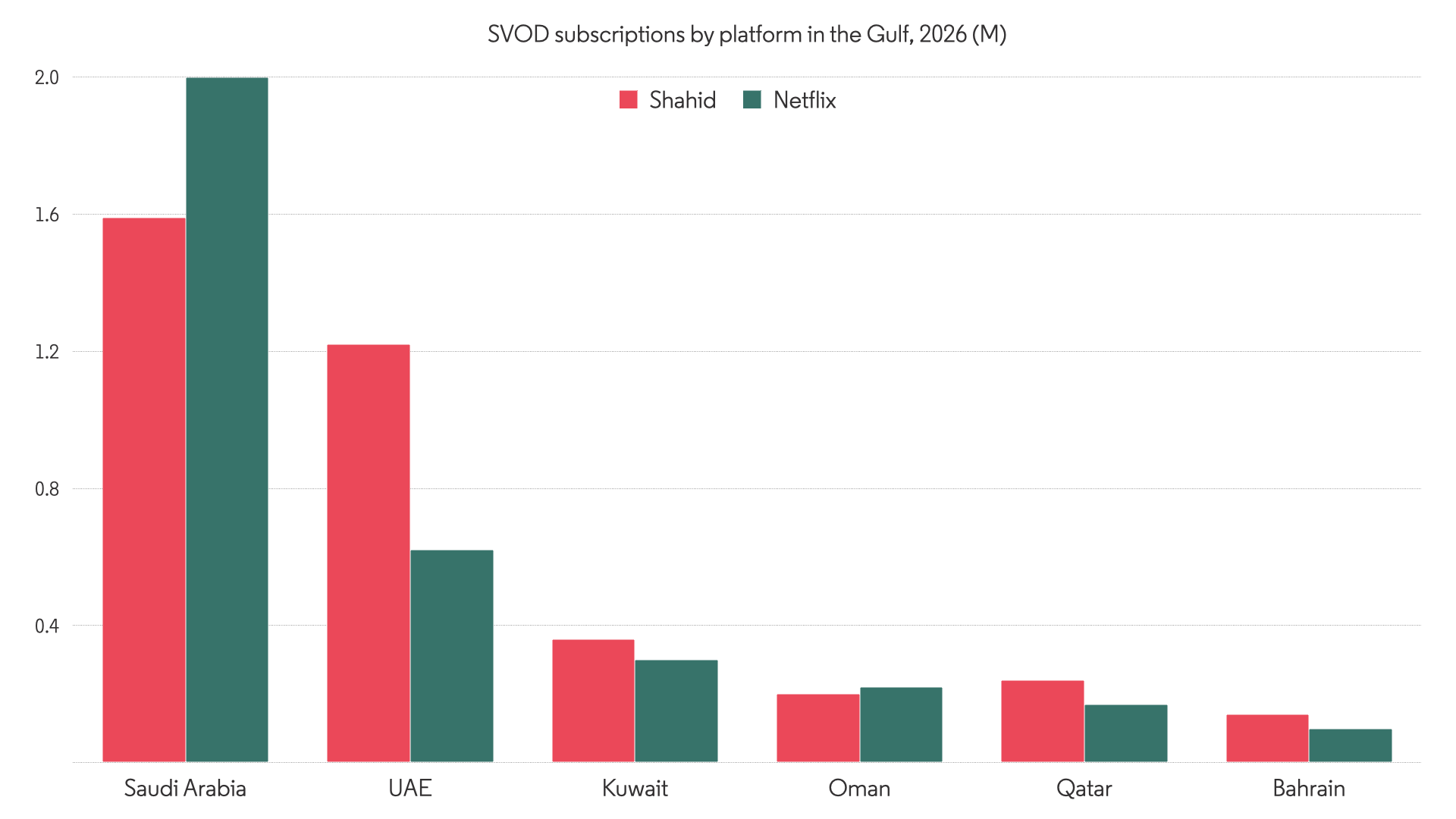
And here, regional beats global. MBC Shahid leads Netflix in SVOD subscriptions in four of the six Gulf markets. In the UAE it is not close: 1.2M subscriptions to Netflix’s 619K, almost 2x. Shahid also leads in Qatar, Kuwait and Bahrain. Netflix holds on in Saudi Arabia, the region’s largest market, with 2.0M against 1.6M, and edges ahead in Oman. Across the bloc, Shahid holds 26% of all SVOD subscriptions and Netflix 24%.
Our read is that Arabic-language content gives Shahid the habit-forming role, with global services layered on top. The Shahid, Disney+ and OSN+ GCC bundle, launched in December 2025, puts three services behind one subscription. In Saudi Arabia, stc tv now bundles Netflix, which strengthens its telco distribution advantage. Netflix and Shahid have even launched a combined subscription. Streaming bundles are rewiring who owns the customer relationship in the Gulf.
OSN+ is forecast to grow by roughly 77% in the UAE, Kuwait and Qatar alike, as the GCC offer builds scale.
But volume is not value. Even where Netflix trails on subscriptions, it earns more from each one. We estimate Netflix revenue per subscription at around 1.5x Shahid’s in the UAE and more than 2x in Saudi Arabia. Shahid wins the household. Netflix often wins the wallet.
Saudi Arabia deserves its own line. Saudi Arabia’s streaming market revenues grow from $1.2B to $1.8B, more than double the four North African markets combined. SVOD and AVOD sit in near parity, at $593M and $575M this year. FAST (free ad-supported streaming TV) triples, from $31M to $94M.
The smaller Gulf markets lean harder on ads. Qatar’s AVOD revenue per head is around $26, the highest in MENA. The UAE is at $22 and Kuwait at $18.
Across the Gulf, AVOD (advertising-funded streaming) is 49% of revenue this year and SVOD (subscription streaming) 48%.
The question is who sits at the centre of the bundle.
Takeaway: the Gulf is mature, so the contest is over anchor status and yield, not subscriber growth.
Oman streaming market: the exception in the Gulf
Oman is the most interesting exception.
It sits in the Gulf, but it behaves a little like North Africa. Advertising leads, with AVOD at $58M against SVOD at $49M. Netflix holds only a narrow lead over Shahid, at 222K subscriptions to 204K. Oman’s streaming revenues grow 62% by 2031, faster than any other Gulf market.
Stacking sits at 1.9x, rising to 2.1x, and SVOD closes the gap on advertising as households add services. A market that starts ad-led can become subscription-led as stacking deepens.
Takeaway: Oman is a bellwether. If its ad-led to subscription-led path holds, North African markets may follow.
The North Africa streaming market: scale, global brands and AVOD
Move to North Africa and nearly every metric flips.
Paying households are scarce. There are around 17 SVOD subscriptions per 100 TV households, against 125 in the Gulf. Stacking is 1.6x. Connectivity is a constraint too. In Morocco, fixed broadband reaches only 38% of households, so mobile does the heavy lifting.
So where does the money come from? Advertising. AVOD makes up around half of North African streaming revenue this year, rising to 52% by 2031, and it already out-earns SVOD in Egypt, Algeria and Morocco. In the Gulf, the mix is balanced. In North Africa, ads lead.
And advertising here largely means YouTube. YouTube accounts for more than 90% of AVOD revenue in each of the four North African markets this year. That leaves real room for local broadcasters, FAST channels and local streaming platforms to build ad businesses of their own.
Egypt grows from $246M to $407M. Algeria and Morocco each pass $200M by 2031. Tunisia is the smallest, rising from $41M to $65M.
Tunisia is also the clue to what is possible. It has the highest penetration in North Africa, at 23 subscriptions per 100 TV households, rising to 32. The difference is connectivity. Fixed broadband coverage is relatively strong, and Arabic-language content does the rest. Shahid holds around 39% of all subscriptions there.
The competitive picture differs from the Gulf. Netflix leads in Egypt, Algeria and Morocco and holds around 30% of the bloc’s subscriptions, against Shahid’s 27%. In Tunisia, Shahid wins outright, with 200K subscriptions to Netflix’s 133K. In Egypt, it is closing in. The gap narrows from 118K subscriptions this year to 63K by 2031.
Now the twist. Shahid has the volume, but not the yield.
Across Egypt, Algeria, Morocco and Tunisia, we estimate Shahid’s SVOD revenue per subscription at under $10 this year. Netflix sits between roughly $43 and $73. That is a gap of roughly five to ten times.
Our read is that Shahid is building reach through low-priced or bundled access, with monetisation still to come. But it leaves the region’s most valuable subscribers more exposed to higher-yielding global rivals.
FAST also triples in North Africa, from $12M to $37M. It is small today. It is a sign that advertisers are finding new ways into markets where few households pay.
Takeaway: North Africa is advertising-first. Reliance on one global platform is a risk, and an opening for local broadcasters and content owners.
MENA SVOD forecast: subscription stacking drives growth
Both blocs run on the same mechanic: layering, not converting.
Across MENA, SVOD subscriptions grow by 16.2M by 2031, while subscribers grow by only 4.6M. In the Gulf, every new paying household brings around 3.4 new subscriptions. In North Africa, it brings around 2.8.
North Africa’s stacking reaches 1.85x in 2031, still short of the 2.2x the Gulf stands at today.
North Africa has 219M people. Every extra dollar of revenue per head is worth around $220M, roughly the size of Algeria’s entire streaming market in 2031. Our forecast adds about $1.40 per head by 2031. The Gulf reaches $52.
As an illustration, not a forecast: closing just 10% of that 2031 gap would add roughly $1B a year on today’s population. That would more than double a bloc forecast to generate $0.9B in total.
Getting there needs penetration first and price second. More households paying for a first service, on mobile-friendly plans. Ad products that scale beyond the biggest platforms. And bundles that make a second service an easy decision.
Takeaway: MENA growth comes mainly from existing payers adding services, so bundling and retention drive forecasts.
What the forecast means for platforms and advertisers
For global platforms, this is one brand with two businesses. In the Gulf, the job is defending share and yield against a local anchor with bundle power. In North Africa, it is scale: ad tiers, local pricing and distribution that reaches mobile-first households.
For regional platforms, the priorities split. In the Gulf, protect the anchor slot, because the bundle is the moat. In North Africa, turn reach into revenue before higher-yielding rivals lock in the best households.
For advertisers and content owners, North Africa is an open field. Audiences are large, paying households are few, and one platform captures almost all of the ad money. Services that can package local content for ad-funded viewing, through AVOD or FAST, have a clear opening.
Three things to watch in MENA streaming
Shahid’s yield in North Africa
If its revenue per subscription starts to rise towards Netflix’s, the land-grab is turning into a business. If not, global platforms keep the best customers.
The crossover markets: Bahrain and Tunisia
In Bahrain, SVOD overtakes AVOD by 2031, at $56M against $52M. In Tunisia, AVOD pulls ahead, at $31M against $29M. Two small markets, heading in opposite directions.
Bundling beyond the Gulf
The GCC bundle and the Netflix-Shahid offer are Gulf-first. If similar deals reach Egypt, Morocco or Algeria, they could lift stacking faster than our forecast assumes.
Takeaway: each indicator tests whether yield, advertising or bundling reshapes the balance between the two blocs.
MENA streaming is not one race. It is two, run on different tracks, at different speeds, with different prizes. The winners will be the ones who stop treating the region as a single market.
Source: 3Vision’s Video Markets Tracker. Explore the full MENA streaming forecast in the Video Markets Tracker by 3Vision.