




On 14 September, the board of SkyShowtime wrote to chief executive Monty Sarhan to confirm that its shareholders, Comcast and Paramount Skydance, had begun a review of strategic options. The letter was explicit that this included "the possibility of a wind down," that no decision had been taken, and that every option remained open. The service continues to operate normally, and employees were asked to keep delivering into 2027.
It is worth being precise about what has and has not happened, because the headlines have run ahead of the facts. SkyShowtime has not been shut down. It has not been sold. What exists today is a formal review in which closure is one named outcome among several, alongside a sale, a restructuring, or absorption into one of the parents' own platforms.
But reviews of this kind rarely conclude with nothing changing, and the strategic logic pointing away from the status quo is not subtle. Paramount Skydance is pursuing Warner Bros. Discovery, a transaction that would bring HBO Max under the same ownership as a 50-50 European joint venture explicitly designed so that neither shareholder competes with it. Comcast, meanwhile, is separating NBC and Sky into a standalone company. Both parents are rethinking their streaming architecture at once, and SkyShowtime sits directly in the path of both.
For most of the 22 European markets SkyShowtime serves, this is an interesting corporate story. For Eastern Europe, it is closer to a structural event. Our Video Markets Tracker data shows why Eastern Europe's streaming market has more riding on the outcome than almost anywhere else in SkyShowtime's footprint.
What SkyShowtime Is in Eastern Europe: Subscription and Revenue Forecast to 2031
SkyShowtime is not a marginal player in the Eastern European streaming market. Across the eight Eastern European markets where it operates, we forecast it reaching 3.8 million streaming subscriptions by 2031, up from 2.2 million this year. Streaming revenue follows a similar curve, growing from just over $91 million in 2026 to around $169 million by 2031, an increase of roughly 85% over the period.
Those numbers describe a service in expansion, not retreat. Our forecast assumes distribution-led growth across Central and Eastern Europe, with the ad-supported tier doing an increasing share of the work.
The footprint is uneven, which concentrates the risk. Poland alone accounts for roughly 40% of SkyShowtime's Eastern European subscription base, growing toward 1.5 million subscriptions by 2031. Romania is the second pillar, reaching 610,000. Czechia and Hungary follow, each landing in the high three hundred thousands to low four hundred thousands. Bulgaria, Croatia, Serbia and Slovakia make up a smaller but strategically useful tail.
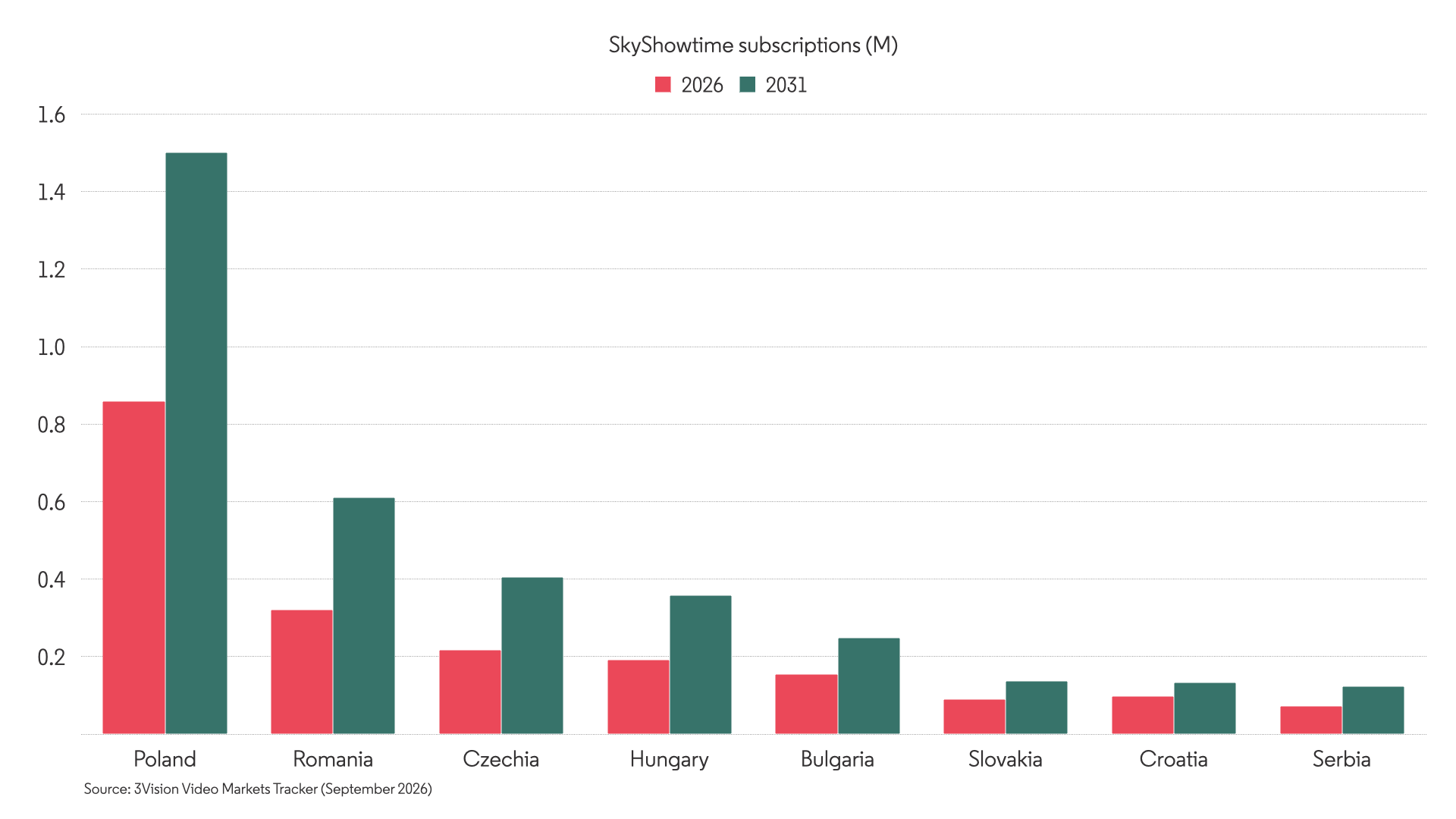
Equally telling is where SkyShowtime is not. It has no presence in Greece, Lithuania, Ukraine or Russia. It went deep in a specific set of markets and left the rest alone, so a wind-down would be felt acutely in a handful of markets rather than diluted across the region.
The most striking number is the ad-supported tier. We forecast SkyShowtime's hybrid (ad-supported) subscriptions in Eastern Europe growing from around 430,000 this year to over 1.45 million by 2031. That is the largest ad-supported premium subscription base of any platform in the region, ahead of Netflix on the same measure. By the end of the forecast period, close to 40% of SkyShowtime's Eastern European subscriptions sit on an ad-supported tier.
Eastern Europe is tilting toward advertising-funded streaming (AVOD and hybrid models) faster than any mature market, and SkyShowtime has become the single largest vehicle for premium ad-supported viewing in the region. The service under review carries the most weight in the transition everyone agrees is coming.
If you invest in or operate within Eastern European streaming, SkyShowtime is a regional pillar, not a peripheral asset. Its scale and its ad-supported base make any decision about its future a market-level event.
How SkyShowtime Grew Through Eastern European Operators and Pay-TV Distribution
To understand what a wind-down would disrupt, you have to understand how SkyShowtime got here.
Its Central and Eastern European expansion has been overwhelmingly distribution-led. In Poland, its scale rests on a strategic partnership with Polsat Plus Group from April 2025, putting the service inside Plus, Polsat Box and Polsat Box Go packages. In Serbia, it launched through Telekom Srbija in December 2025. In Bulgaria and Croatia, it arrived via United Group, integrated into the EON environment on Vivacom and Telemach with two linear channels alongside the on-demand service.
Sarhan has described being in business with operators as a natural fit for Central and Eastern Europe, pointing to a market context "where linear television is still so strong and durable." The operator layer was not a supplementary channel for this business. It was the primary one.
Eastern Europe is a streaming market won through the distribution layer rather than the direct-to-consumer app, because pay-TV operators and telco relationships remain the default route into the household. The irony is that the strategy which made it competitive is also what makes an exit unusually complicated.
When subscriptions live inside operator bundles, billed on a telco invoice and activated through a set-top box, a shutdown is not a matter of switching off an app and emailing subscribers. It means unwinding multi-market carriage agreements, withdrawing linear channels from operator line-ups, and handing several telcos a hole in their premium content proposition with contractual terms still running. In many cases the subscriber relationship is not SkyShowtime's to migrate. It belongs to the operator.
That is why the most consequential conversations about a wind-down will not happen in Los Angeles or London. They will happen between operators and whoever wants to fill the gap.
For operators and telcos, the lesson is clear: owning the subscriber relationship is the scarcest asset in this market. For investors and broadcasters, distribution partnerships, not app downloads, decide how durable a streamer's Eastern European base is, and how hard it is to leave.
Where Would SkyShowtime's 3.8 Million Eastern European Subscriptions Go?
The obvious answer is HBO Max. If Paramount Skydance completes its acquisition of Warner Bros. Discovery, HBO Max becomes the natural group platform for Europe. But SkyShowtime is a 50-50 joint venture, and Comcast has no obvious reason to see NBCUniversal content folded into a platform Paramount Skydance controls.
The complication, in the Eastern European SVOD market, is overlap between SkyShowtime and HBO Max. HBO Max is already established in most of the markets where SkyShowtime operates, with its own carriage arrangements across the region. A migration therefore does not transfer 3.8 million incremental subscriptions to a platform with no presence. It consolidates two overlapping premium services into one, in markets where a meaningful share of engaged households already subscribe to both. Some of that base consolidates. Some of it disappears, because a household paying for two premium services rarely keeps paying twice.
In Romania, for example, SkyShowtime is forecast to end the period ahead of HBO Max on subscriptions, which makes the combination less an absorption than a merger of near-equals with substantial duplication. Poland, where SkyShowtime's operator relationships are strongest and its base largest, would see the biggest single concentration of disruption in the region.
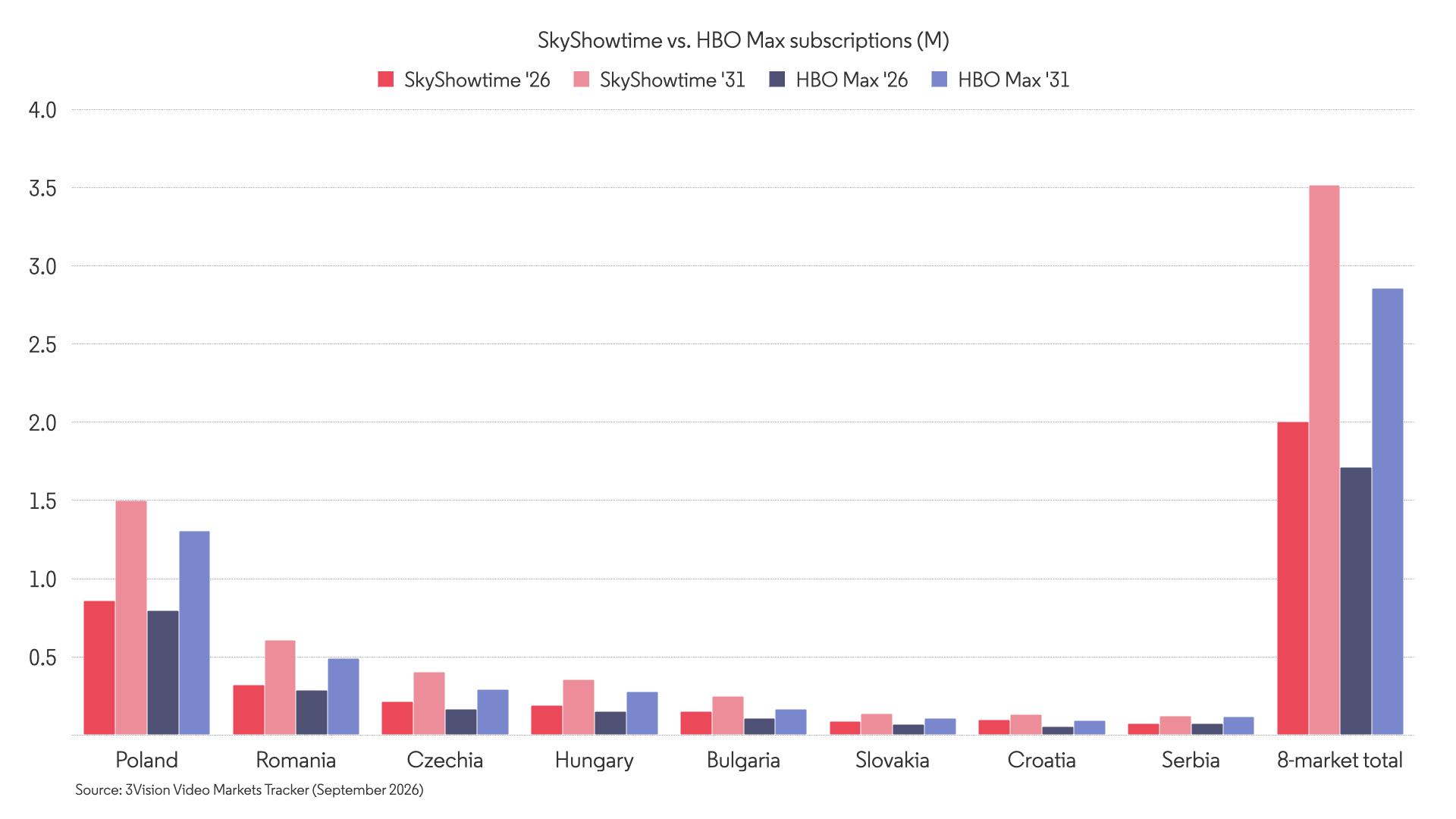
The second answer, and the one we think is underrated, is that local champions and domestic streaming platforms benefit. Domestic platforms are already winning: Oneplay leads Czechia outright, RTL+ is set to become Hungary's largest service, and Polsat Box Go heads the local field in Poland. These are precisely the markets where SkyShowtime is strongest, and their operators are precisely the partners a departing SkyShowtime would leave behind.
A premium slot inside an operator bundle does not stay empty. If SkyShowtime vacates its slot in operator packages, the immediate beneficiaries are whoever can fill it fastest, and local aggregators are well placed to do so. The most likely outcome is not a clean transfer from one global platform to another. It is redistribution, with domestic services capturing a share that the global consolidation narrative does not anticipate, and with content returning to the market through both joint venture partners.
The third consequence has the longest tail. If SkyShowtime disappears, the region loses its largest premium ad-supported streaming subscription base at exactly the moment ad-funded models are scaling fastest. That base is the product of a specific pricing architecture, deployed through operator bundles, in markets where an ad-supported entry point is often the only way a premium subscription becomes affordable. Rebuilding that takes years, and whoever moves first inherits a significant structural advantage.
For content distributors and operators, a wind-down is unlikely to produce a tidy transfer to one winner. Consolidation, redistribution and a lost ad-supported base would play out at once, so model the outcome market by market.
SkyShowtime Wind-Down and the Eastern Europe Content Rights Market
Rights holders should think about a further implication now rather than in 2027. SkyShowtime is the exclusive regional home for a large volume of Paramount, NBCUniversal, Sky Studios and Showtime content. If the service winds down, that content does not simply move to HBO Max. Comcast and Paramount Skydance own the joint venture, so their content returns to them, and each can license it back into the market. A significant content catalogue needs a new streaming destination across eight Eastern European markets.
That would be the largest single shift in content availability the region has seen since the Western platforms exited Russia. For local broadcasters and domestic streamers who have spent three years competing against a well-funded aggregator of Hollywood output, it would be an unusual buying opportunity. For rights holders, it raises a harder question: in markets where advertising is scaling faster than subscription and local platforms hold the distribution relationships, is a direct-to-consumer premium tier still the right monetisation route, or is licensing into the local ecosystem now the better return?
We would expect Poland, Serbia and Romania to answer that question differently. The outcome of this review will not land uniformly across Eastern Europe, because Eastern Europe is not a uniform market.
For rights holders, production companies and local broadcasters, licensing strategy in Eastern Europe should be built country by country. A shift in where premium Hollywood output sits reopens the choice between direct-to-consumer and local licensing.
The Takeaway: SkyShowtime's Impact on Eastern Europe's Streaming Market
No decision has been made, and SkyShowtime may yet emerge from this review intact, restructured, or under new ownership. But the strategic gravity is unmistakable, and the prudent assumption for anyone with exposure to these markets is that the service's Eastern European footprint looks different in three years than it does today.
Our data makes clear that the regional stakes are higher than the corporate story suggests. SkyShowtime is a service forecast to reach 3.8 million subscriptions and $169 million in revenue across eight markets, carrying the region's largest premium ad-supported base, embedded inside the operator relationships that determine how Eastern European households actually buy television.
Unwind that, and the effects spread through operator bundles, competitive rankings, ad-supported economics and the content market at once. The winners are unlikely to be the ones the headlines predict.
For regulators, analysts and investors, the wider message is that consolidation decisions taken in Los Angeles or London can reshape local competition, ad-supported economics and content supply.
Understanding where the exposure sits, and where the opportunity opens up, requires platform-level visibility in each individual market rather than a regional view. That is what 3Vision's Video Markets Tracker is built for. If you want to see what a SkyShowtime wind-down would mean for the Eastern European markets that matter to you, we would be glad to walk you through the numbers.
The 3Vision Video Markets Tracker covers SVOD, AVOD, FAST, TVOD and EST across 400+ services in 70+ countries, with platform-level and country-level data projected to 2031. To arrange a walkthrough of the 3Vision Video Markets Tracker, get in touch.


.jpg)

.jpg)
.jpg)




.svg)


