




Warner Bros. Discovery’s international HBO Max rollout is beginning to bring key theatrical movie windows closer to the US model, particularly at Pay-One.
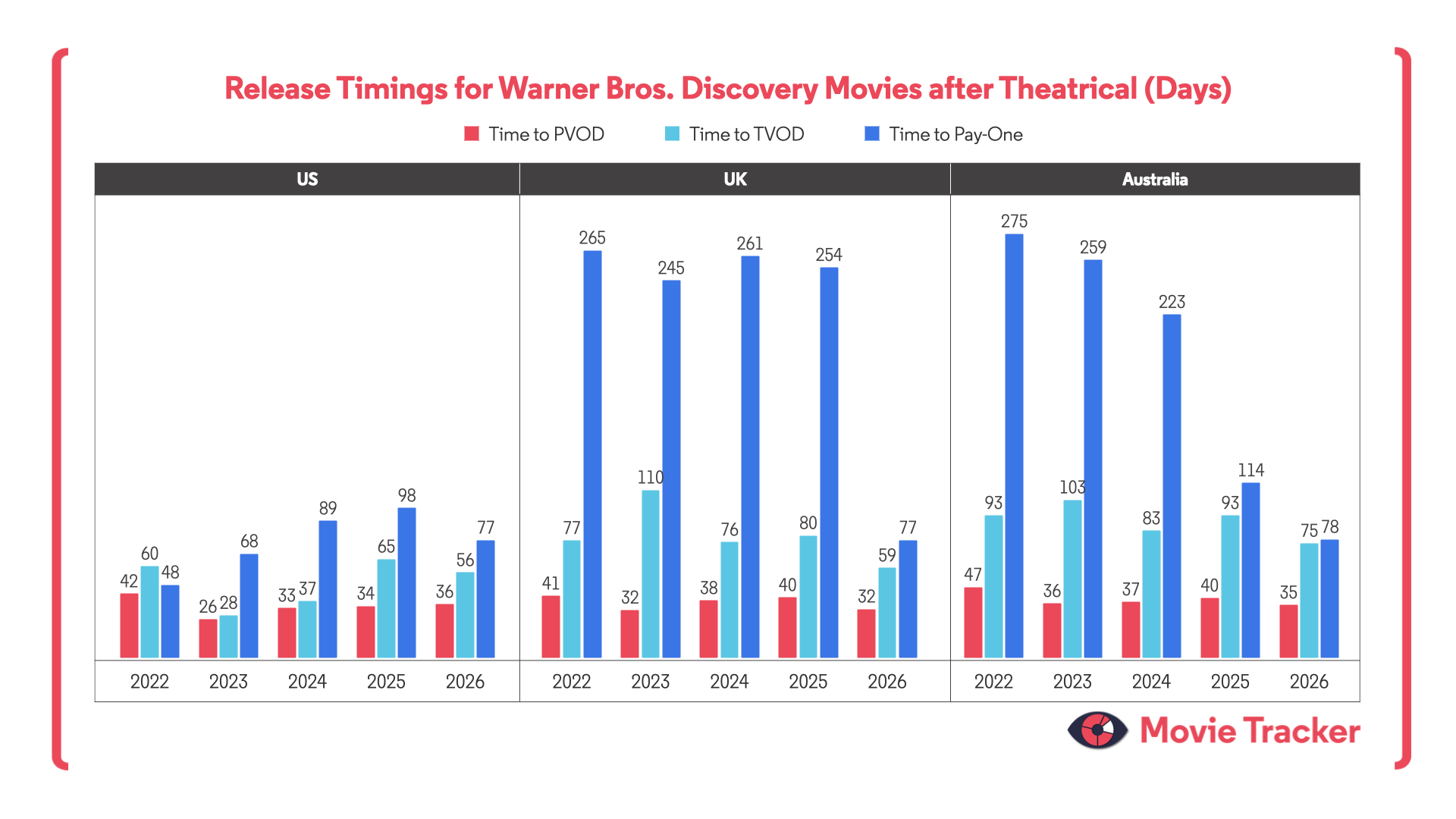
3Vision’s Movie Tracker data shows that PVOD and TVOD windows for Warner Bros. Discovery titles have remained relatively stable across the US, UK and Australia. The bigger change is happening in Pay-One, where the launch of HBO Max is materially altering where - and how quickly - Warner Bros. Discovery movies become available to subscription audiences after theatrical release.
In the US, Warner Bros. Discovery has had a more established direct-to-consumer window for several years. HBO Max launched in the market first, giving Warner Bros. Discovery an owned streaming destination for its theatrical films much earlier than in many international territories. This is reflected in the data: US Pay-One timings have been relatively compressed and consistent, ranging between 48 and 98 days across 2022–2026, with the 2026 average sitting at 77 days.
The UK historically followed a very different pattern. Warner Bros. Discovery’s Pay-One output was long associated with Sky, meaning films typically reached subscription audiences much later than in the US. Between 2022 and 2025, the UK Pay-One window for Warner Bros. Discovery movies sat between 245 and 265 days after theatrical release. In 2026, however, this fell sharply to 77 days. That shift coincides with the launch of HBO Max in the UK, where the Pay-One window is now shared between Sky and HBO Max rather than operating solely through the previous Sky-led model.
Australia shows a similar transition, though slightly earlier. Historically, Warner Bros. Discovery’s Pay-One output in the market sat with Foxtel, producing long Pay-One windows of 275 days in 2022, 259 days in 2023 and 223 days in 2024. Following the launch of HBO Max in Australia in 2025, that window shortened significantly, falling to 114 days in 2025 and then 78 days in 2026. Unlike the UK, where Sky remains part of the Pay-One picture, Australia has moved from the historic Foxtel arrangement to HBO Max as the Pay-One destination.
The result is a clear narrowing between the US and these international markets. In 2026, the Pay-One window for Warner Bros. Discovery movies is almost identical across all three territories: 77 days in both the US and UK, and 78 days in Australia. This marks a significant departure from the previous international pattern, where the UK and Australia were often operating roughly eight to nine months behind theatrical release.
Transactional windows have not moved in the same dramatic way. PVOD remains broadly stable, sitting in the mid-30-day range across all three markets in 2026: 36 days in the US, 32 days in the UK and 35 days in Australia. TVOD shows more market variation, but the direction is still towards closer alignment, with 2026 windows of 56 days in the US, 59 days in the UK and 75 days in Australia.
The strategic implication is that HBO Max is not simply being added as another downstream platform. In markets where Warner Bros. Discovery now has a direct-to-consumer service, Pay-One is being repositioned much closer to the theatrical and transactional windows. This gives Warner Bros. Discovery more control over how quickly its studio titles are used to support its streaming proposition.
For Pay-One partners, the picture is more nuanced. In the UK, Sky remains central, but its role is evolving. Warner Bros. Discovery is no longer relying only on a Sky-led Pay-One pathway; HBO Max now sits alongside Sky, with the service bundled into Sky packages for many customers. In Australia, the shift is cleaner: the market has moved away from the historic Foxtel Pay-One model towards HBO Max as the primary subscription destination for Warner Bros. Discovery movies.
The broader pattern is clear. HBO Max’s rollout is helping Warner Bros. Discovery globalise the kind of shorter Pay-One window it has already established in the US. As the service expands internationally, the gap between domestic and international movie windowing is narrowing - and Warner Bros. Discovery’s own streaming platform is becoming central to how that value is captured.


.jpg)
.jpg)


.jpg)


.svg)


