




Fox's recent $22 billion bid for Roku hands the media giant something it has never been able to build on its own: a foothold in the operating layer of Connected TV, with direct access to the more than 100 million devices Roku powers. It's the latest chapter in a familiar playbook of legacy media companies buying their way into the technology and device infrastructure that would take years, if not decades, to grow organically.
But the real prize isn't distribution. It's advertising.
Where the Real Value Lies
Both companies bring formidable TV advertising businesses to the table. Roku, notably, now generates more profit from advertising than from hardware sales, which indicates where its priorities and future, lie. Add to that two well-established FAST and AVOD platforms, and the strategic logic starts to come into focus.
Tubi and The Roku Channel are among the most popular ad-supported streaming platforms in the US. And while Tubi is primarily focused on and largely driven by AVOD content, both have been steadily expanding their FAST offering into international markets like Canada and the UK. Fox has already sunk significant investment into its ad-supported ecosystem, most visibly through its rights to major sports properties like the Super Bowl. Roku, meanwhile, has pushed their EPG technology, using its data capabilities to personalise the Live TV experience through user-curated channels and increasingly sophisticated recommendation engines.
Two Very Different Playbooks
On the content strategy front, Tubi and The Roku Channel are pursuing almost opposite approaches.
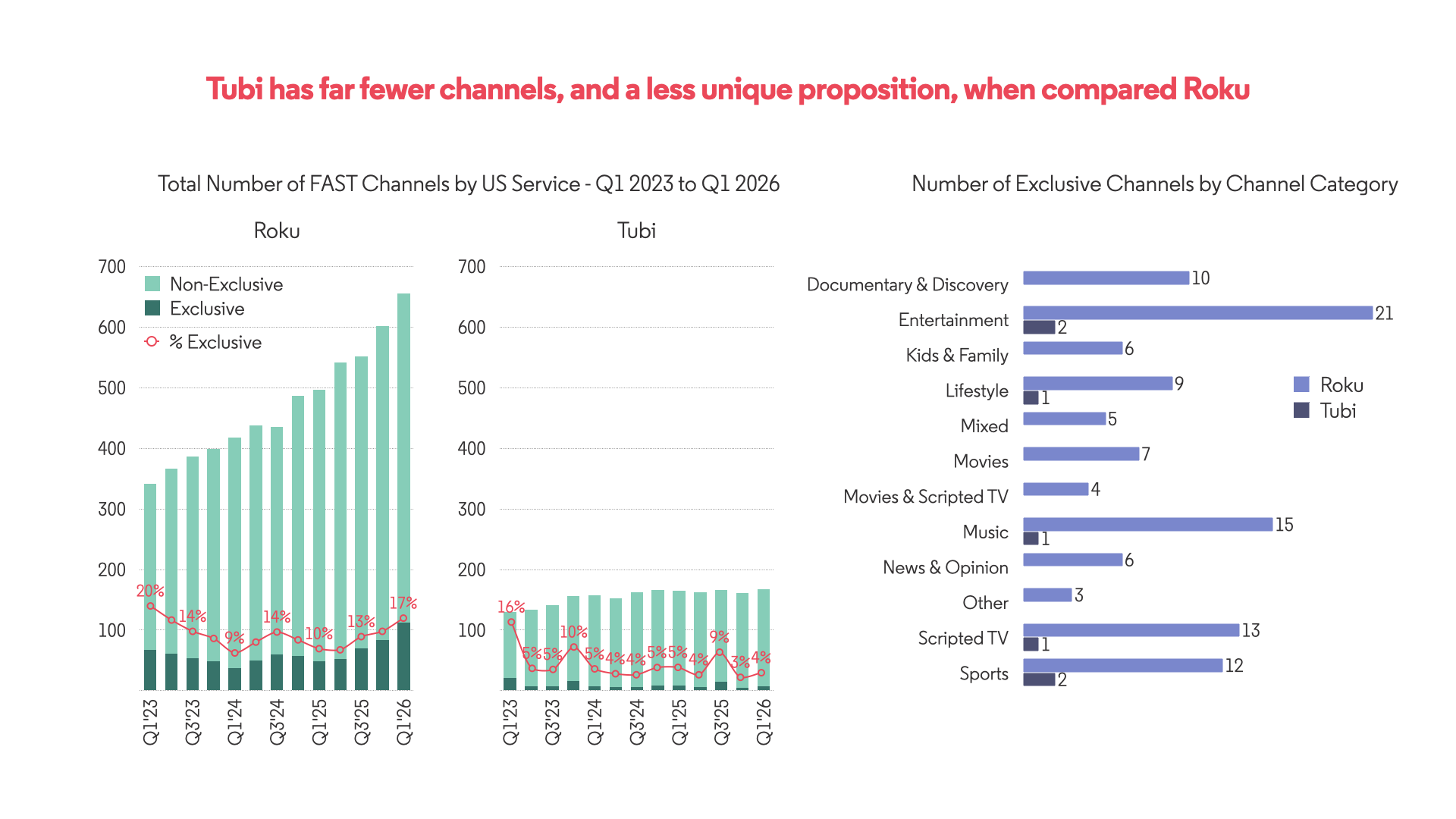
The Roku Channel is one of the largest and fastest-growing FAST platforms in the US, with a lineup exceeding 600 channels. Tubi, by contrast, has held steady at around 150 channels (excluding local news), which is a far more curated, focused catalogue that avoids overwhelming its users.
But "curated" doesn't necessarily mean "unique." Only 4% of Tubi's lineup is exclusive to the platform, unavailable on other major FAST platforms. Roku fares considerably better on this front, with 17% of its Live TV offering exclusive, bolstered by a growing range of owned-and-operated channels.
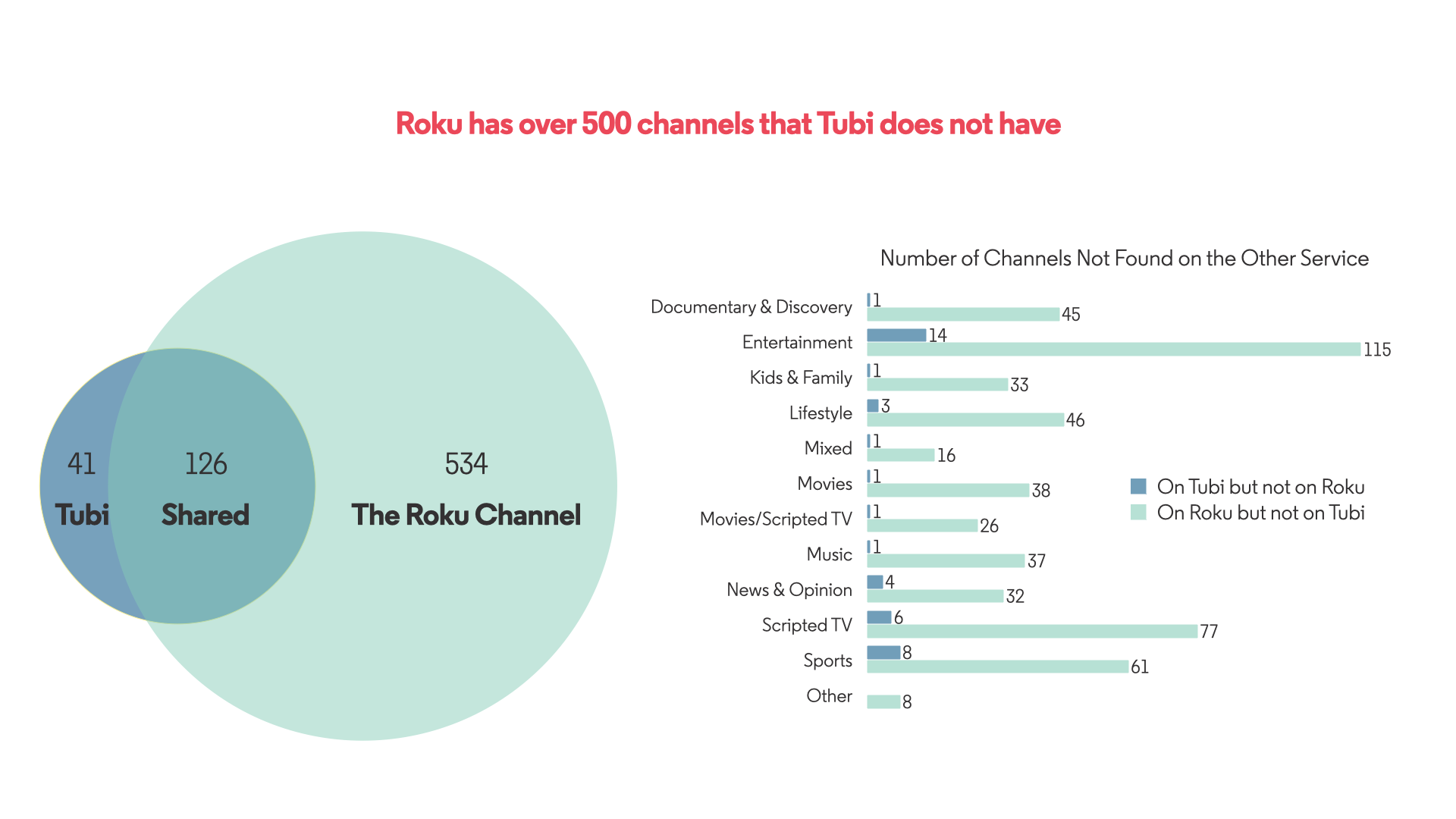
Zoom out, and the overlap between the two platforms is surprisingly thin. Roughly 80% of Roku's channel lineup doesn't exist on Tubi at all. What Roku does bring to Tubi is scale and a sizeable ecosystem of FAST channel partners that meaningfully expands both content variety and advertising inventory.
Complementary, Not Competing
It's still early days for how Fox plans to operate the two platforms, but the likely path forward is one of complementary positioning rather than consolidation. Tubi skews toward intentional on-demand viewing, the kind of engaged audience that tends to command higher ad value. Roku, thanks to its deep integration into the TV's home UI, is built for habitual, lean-back viewing. Together, they cover more ground than either could alone.
According The Bigger Picture
According to 3Vision's Video Market Tracker, the US FAST and AVOD market is projected to surpass $40 billion annually by 2028. Tubi and The Roku Channel already sit at the centre of that growth story, capturing a meaningful share of the market.
But scale alone won't determine who wins. As one of the largest Smart TV manufacturers in the world, Roku holds something arguably more valuable: first-party data on tens of millions of households. That data, not just channel count, is what will ultimately sharpen targeting, measurement, and personalisation across the combined business.
The Fox-Roku deal isn't really about merging two overlapping FAST services. The channel-level data makes that clear: Tubi and The Roku Channel serve different catalogues, follow different exclusivity strategies, and attract different viewing behaviours, with only modest overlap between them. This is about Fox acquiring not only Roku’s reach and distribution network, but also an operating system that determines what people watch and a first-party data layer that taps into the cutting-edge of the advertising market.




.jpg)





.svg)


