




Almost everywhere in the world, the streaming story of the past few years has been one of consolidation around a handful of American platforms. Netflix, Disney+ and Amazon set the pace, local players retreat to the margins, and the only real question is how quickly advertising tiers and password-sharing crackdowns squeeze more revenue out of a maturing base.
Eastern Europe is quietly writing a different story.
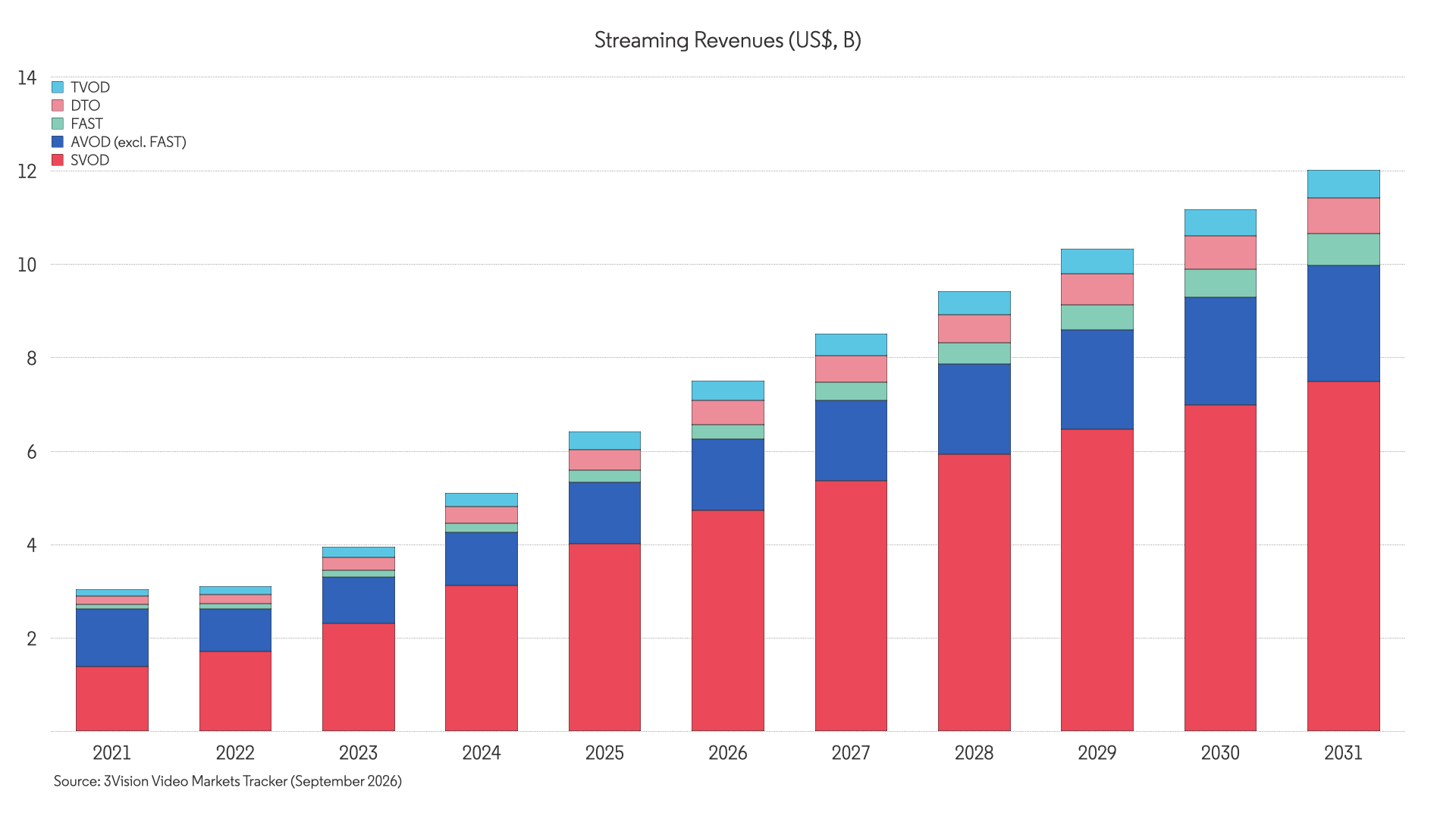
Across the twelve markets we track from Bulgaria to Russia, streaming is growing fast: SVOD subscriptions climb from 89.8 million this year to 125.8 million by 2031, and total streaming revenues expand around 60% to reach roughly $12 billion. But the shape of that growth is where the region breaks from the global template. Two features stand out, and neither fits the consolidation narrative. First, local platforms are not fading here - in several markets they are winning outright. Second, the region is tilting toward ad-supported economics faster and further than the mature West, to the point where one market is already advertising-led.
For distributors, platforms and investors used to reading "Eastern Europe" as a single, global-platform-shaped block, both features carry a warning: the playbook that works elsewhere will misfire here. This is a region that has to be read market by market, and the surface-level view - Netflix on top, everyone else chasing - hides almost everything that matters.
Local still wins
Start with the claim that sounds least likely in 2026: in market after market across Eastern Europe, the largest streaming service is not a global platform.
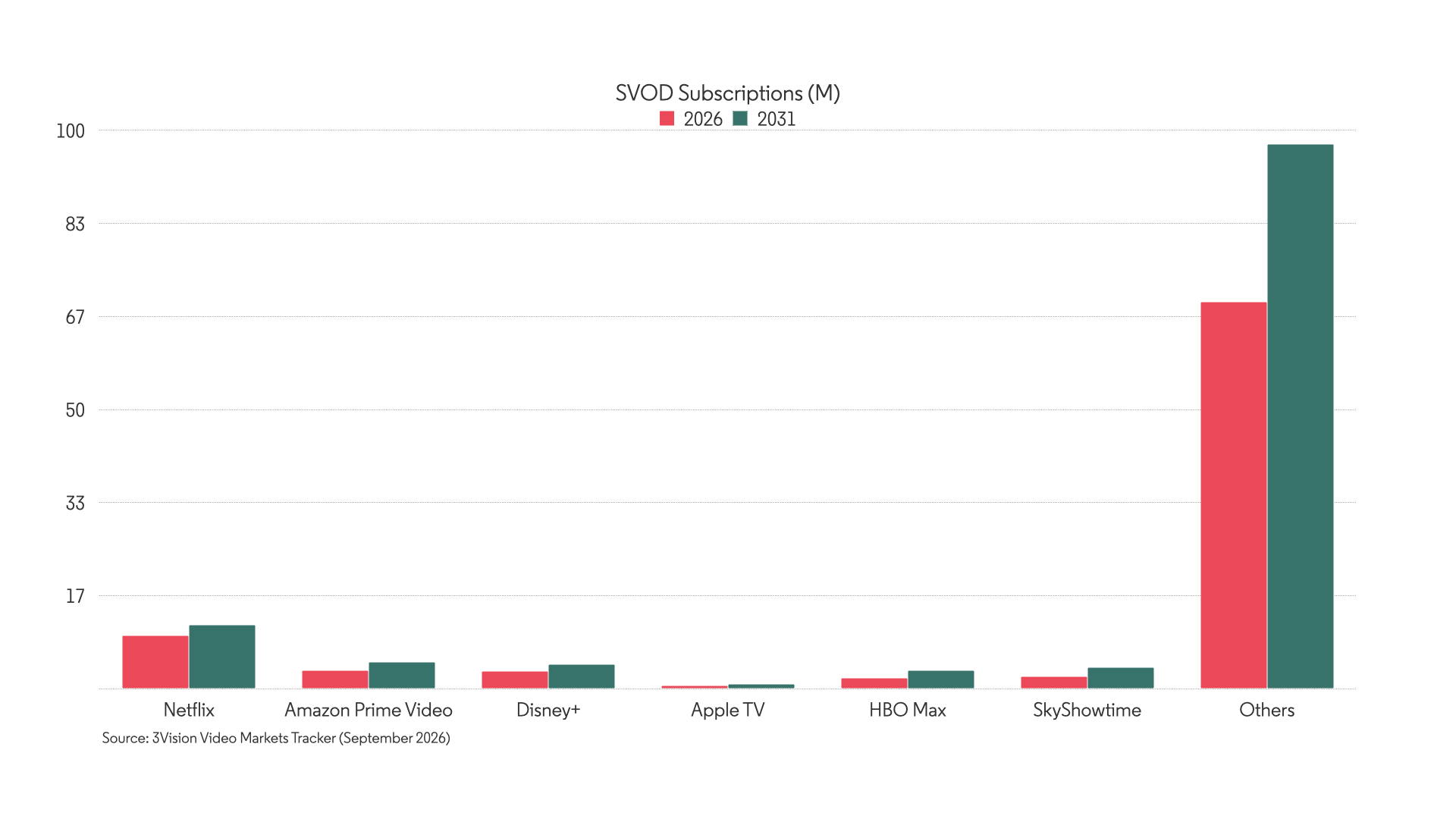
Czechia is the cleanest example. The domestic leader is Oneplay, the service created by the 2025 merger of Voyo and O2 TV, which pulls together premium sport, local production and aggregated content under one roof. Oneplay does not merely compete with the global platforms in the Czech market - it dwarfs them, scaling past 2 million subscriptions by 2031 while Netflix, the largest of the internationals, sits around the one-million mark. In a market of this size, the gap between first and second place is not a rounding error. It is the difference between a service that sets the terms of the market and one that takes what is left.
Hungary tells a similar story with a different protagonist. Here the domestic champion is RTL+, RTL Hungary's platform built on local reality, drama and documentary originals. RTL+ is not standing still while Netflix pulls away; it is doing the opposite. Over the forecast period it scales to around 1.1 million subscriptions and overtakes Netflix to become the single largest service in the market. A broadcaster-owned streamer, powered by content made specifically for its home audience, beating the world's most valuable entertainment brand on its own turf - that is not supposed to happen according to the global script.
Move around the region and the pattern repeats with local variations. In the Baltics, the regional platform Go3 remains the anchor of the Lithuanian market, holding the top position as global services scale around it. In Ukraine, the domestic platform Megogo is the undisputed centre of gravity, rebuilding the market after the shock of 2022 and staying comfortably ahead of Netflix as the American platform re-establishes itself. Even in Poland, the region's second-largest market by revenue and a genuine battleground for the global platforms, the largest single local service is Polsat Box Go, sitting at the head of a crowded field of domestic and international players.
Then there is Russia, which is best understood not as an exception to this pattern but as its logical extreme. Following the withdrawal of the Western platforms, the market is now entirely domestic: Netflix, Disney+ and Amazon register no subscribers at all. In their place, a cluster of home-grown services has not just filled the gap but expanded the market. Kinopoisk, sold within the Yandex Plus bundle, grows toward 22 million subscriptions, with Okko, Wink and Kion all scaling into eight-figure territory behind it. Strip out the global platforms entirely, and Eastern Europe's biggest streaming market kept right on growing - toward 85 million subscriptions by 2031.
What links these markets is not that global platforms are weak - Netflix, Disney+ and Amazon are growing almost everywhere in the region. It is that local players have three structural advantages the global platforms cannot easily match.
The first is content. Local-language originals, live sport and broadcaster libraries travel poorly across borders but land hard at home, and in markets where a Netflix subscription is a meaningful share of household discretionary spend, "the shows everyone here is actually talking about" is a powerful proposition.
The second is bundling. Eastern Europe is a region won through the distribution layer rather than the direct-to-consumer app. Russia's platforms ride inside telecom and e-commerce ecosystems - Yandex Plus, SberPrime and the rest - that fold streaming into a wider subscription a household was already paying for. The same logic is visible across the region's open markets, where carriage through pay-TV operators and telcos does much of the heavy lifting.
The third is consolidation. Oneplay is the clearest case: two competing services became one market leader overnight. As local players merge and aggregate, they build the scale that used to be the exclusive advantage of the globals.
None of this is visible from the top line. "Netflix is the number-one international platform in Eastern Europe" is true, and almost useless as a guide to strategy. The competitive reality - who actually leads, by how much, and why - only resolves at the platform level, market by market. That is precisely the layer where a regional average tells you nothing and where the wrong assumption costs real money.
The ad-first tilt
The second way Eastern Europe departs from the global script is in how it makes money.
In mature markets, subscription is the engine and advertising is the increasingly important passenger. In Eastern Europe, advertising is climbing into the driver's seat far earlier. Across the region, AVOD revenues grow around 73% over the forecast period to reach $3.2 billion, and FAST grows faster still - up roughly 120% to $683 million - while subscription revenue, though larger in absolute terms, expands more slowly at around 58%. Advertising-supported streaming is not a mature-market afterthought being retrofitted here; it is scaling as a primary growth vector.
The hybrid tier tells the same story from the platform side. Ad-supported tiers within the global SVOD services are emerging rapidly from a low base and scaling across every major platform through the forecast period. By 2031, hybrid users climb toward 1.4 million for Netflix and 1.5 million for SkyShowtime, with similar momentum across HBO Max and Disney+. In a region this price-sensitive, the ad-tier is not a defensive option to slow churn - it is becoming a core monetisation lever, and in some cases the primary way a household enters a premium service at all.
The clearest signpost sits in Ukraine. There, the market has already crossed a line the rest of the region is only approaching: advertising is the single largest revenue pool. By 2031, AVOD in Ukraine reaches around $189 million, ahead of SVOD at roughly $160 million, as a rebuilding advertising infrastructure and a large free, ad-supported audience outweigh a still-recovering subscription base. Ukraine is an unusual case, shaped by its recent history, but it is a genuine glimpse of where price-sensitive streaming economics point when advertising, rather than subscription, becomes the path of least resistance for both viewers and platforms.
The reason this is happening earlier in Eastern Europe than in Western Europe or North America is not complicated, but it is consequential. Lower purchasing power and acute price sensitivity mean that the free, ad-funded tier is not a downgrade from a paid subscription - for many households it is the default. YouTube-led free inventory is a major force in several markets, FAST is scaling from a low base at triple-digit rates, and every global platform now leads with an ad-supported price point. The result is a region where the advertising share of the streaming economy rises across every market we track, and where the question for a rights holder is increasingly not "how do I get paid a subscription share" but "how do I get paid an advertising one."
This has direct commercial implications. A content strategy built around premium subscription windows, designed for markets where SVOD is 70% or more of the streaming economy, is calibrated for the wrong region. In Eastern Europe, the value is migrating toward advertising and hybrid models, and it is doing so on a market-by-market clock. Knowing exactly how fast - which market is already ad-led, which is 30% of the way there, which retains a stubbornly subscription-heavy mix - is the difference between monetising the shift and being caught behind it.
So where does the money actually sit?
For anyone deciding where to spend attention, the temptation is to treat a $12 billion region as a single opportunity. The data argues strongly against it, because the growth is lumpy in ways the headline hides.
Two markets, Russia and Poland, account for the majority of the region's streaming revenue between them, with Russia alone reaching around $5 billion by 2031. That concentration is well understood. What is less well understood is the shape of everything below it. The third-largest revenue market is not one of the usual names - it is the Czech Republic, which reaches roughly $881 million by 2031 and sits clearly above the mid-pack. A distributor prioritising by instinct would likely overlook it; a distributor prioritising by data would not.
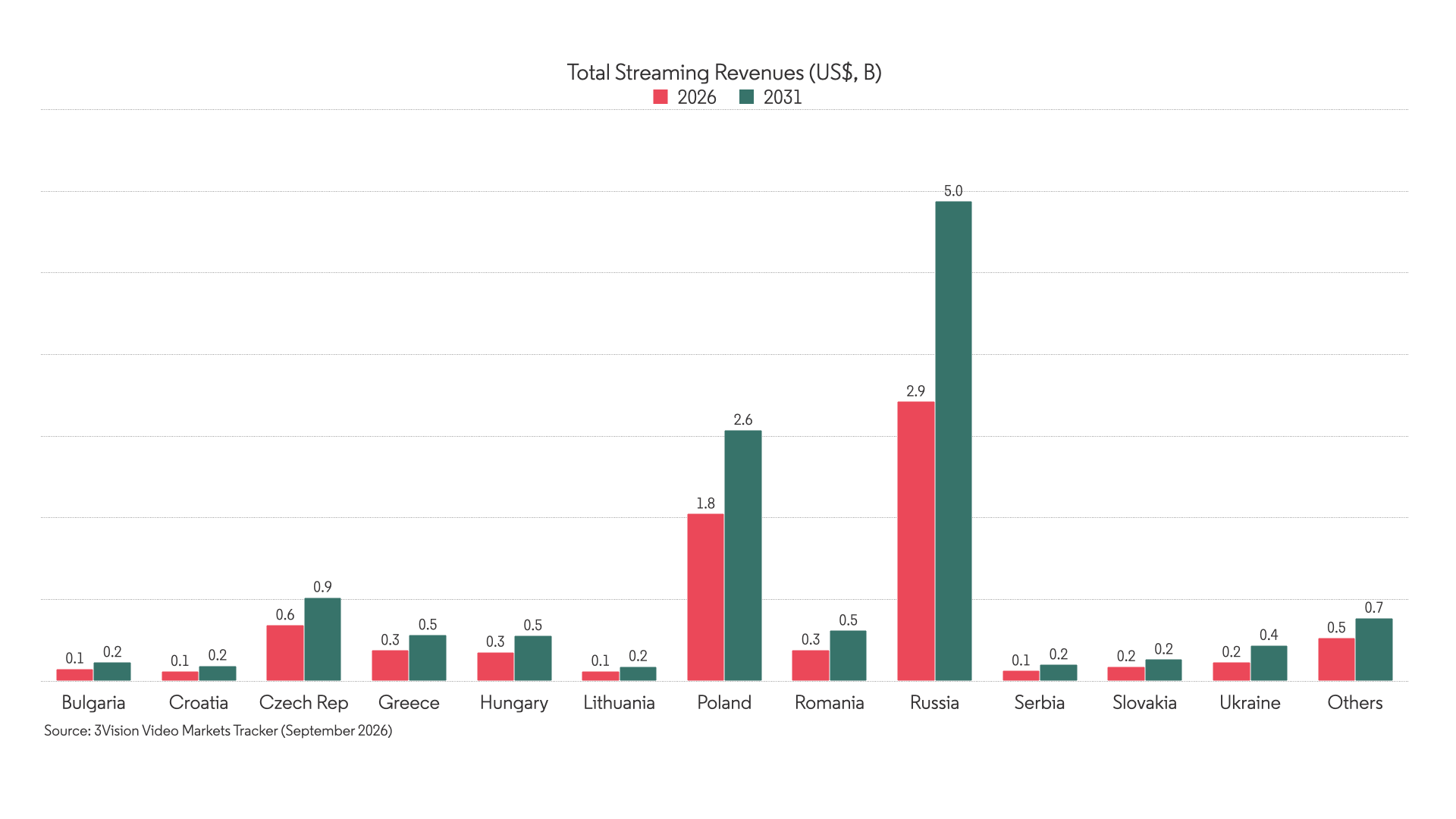
And the fastest-growing markets are not the biggest ones. Ukraine's streaming revenue grows around 89% over the forecast period, and Serbia around 58% - rates that outstrip the regional leaders, off smaller bases. The markets with the most momentum, in other words, are not the markets with the most money, and the two lists do not overlap the way intuition suggests. A strategy that follows current size will miss where the growth is coming from; a strategy that follows growth rates alone will misjudge where the money actually is.
This is the practical case against reading Eastern Europe as one market. The right entry point for a subscription-led premium service, an ad-funded catalogue play and a FAST channel operator are three different countries - and none of them is necessarily the largest one. The regional average is not a strategy. The country-by-country picture is.
The takeaway
Eastern Europe rewards the operators who stop assuming it works like everywhere else. Local champions are not retreating - they are consolidating, bundling and, in several markets, leading outright. Advertising is not a mature-market afterthought - it is arriving early, scaling fast, and in at least one market already sits at the centre of the economy. And the region's $12 billion is not evenly spread - it is concentrated, surprising in its third place, and fastest where it is smallest.
The through-line is that the global playbook underperforms here precisely because it flattens these differences. Winning in Eastern Europe means reading each market on its own terms: who really leads, how quickly the ad-first tilt is arriving, and where the growth and the money actually sit - which, more often than not, are not the same place.
That level of resolution - platform by platform, market by market, out to 2031 - is exactly what the Video Markets Tracker is built to provide. The figures in this piece are the outline. If you would like to see the full picture for the markets that matter to you, we would be glad to walk you through it.
The 3Vision Video Markets Tracker covers SVOD, AVOD, FAST, TVOD and EST across 400+ services in 70+ countries, with platform-level and country-level data projected to 2031. To arrange a walkthrough, get in touch.




.jpg)





.svg)


