




Paramount’s movie windowing strategy shows a different pattern to Disney and Warner Bros. Discovery. While Paramount+ gives the studio a clear owned Pay-One destination, 3Vision’s Movie Tracker data shows that international Pay-One sharing arrangements continue to keep the UK and Australia on a longer timeline than the US.
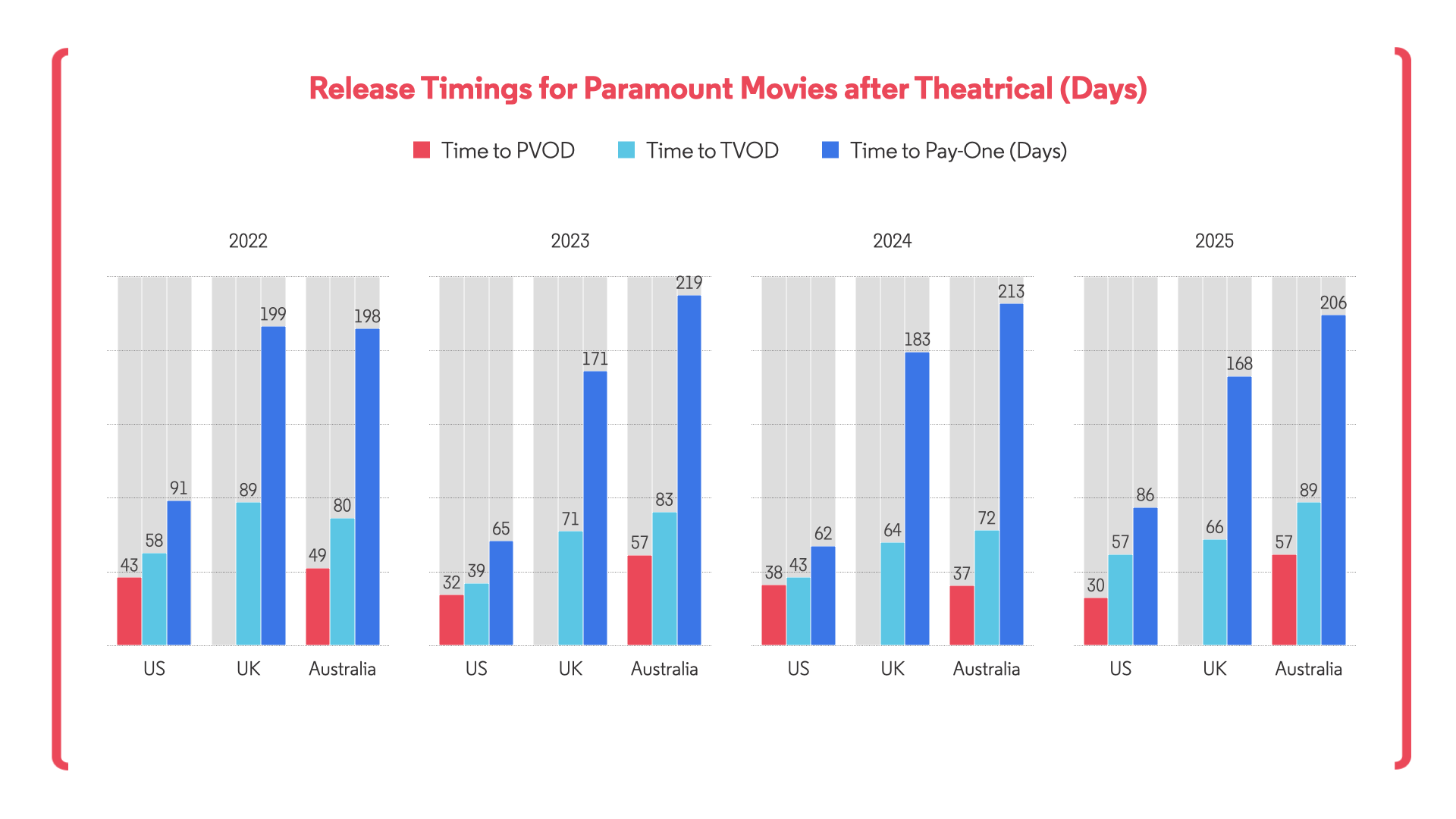
In the US, Paramount’s Pay-One window moved close to the two-month mark in 2023 and 2024, with titles reaching Paramount+ after an average of 65 days in 2023 and 62 days in 2024. This created one of the more compressed studio-to-streaming models, with films moving from theatrical release to PVOD, TVOD and Paramount+ in relatively quick succession.
That has started to shift. In 2025, the US Pay-One window increased to 86 days, moving Paramount+ closer to a three-month post-theatrical window. This gives the transactional windows more room to operate before the subscription premiere. The US PVOD window remained early, at 30 days, while regular TVOD followed at 57 days, creating a wider gap between premium and standard transactional availability than in the previous two years.
That gap is important. In 2023 and 2024, Paramount’s US PVOD and TVOD windows were separated by little more than a week, with PVOD at 32 days and TVOD at 39 days in 2023, then PVOD at 38 days and TVOD at 43 days in 2024. By 2025, the gap had widened to almost a month. With Paramount+ pushed further out, PVOD has a longer period to capture premium rental and purchase demand before regular TVOD pricing arrives.
The UK follows a different model. Paramount has not engaged with PVOD in the market so far, meaning the transactional window is centred on regular TVOD. This window has remained relatively stable, moving from 89 days in 2022 to 71 days in 2023, 64 days in 2024 and 66 days in 2025.
The larger difference is at Pay-One. UK Pay-One timings remain much longer than in the US, sitting at 199 days in 2022, 171 days in 2023, 183 days in 2024 and 168 days in 2025. This reflects the structure of the UK market, where Paramount movies are shared between Paramount+ and Sky at Pay-One. That shared window allows Paramount+ access to the studio’s films while the distribution arm continues to make revenue through Sky, but it also keeps the average window well above the US, where Paramount+ sits as the more direct first subscription destination.
Australia shows a similar dynamic. Paramount has continued to use PVOD in the market, with windows of 49 days in 2022, 57 days in 2023, 37 days in 2024 and 57 days in 2025. Regular TVOD has also remained broadly stable, sitting between 72 and 89 days across the period.
As in the UK, the major difference is Pay-One. Australia’s Pay-One window has consistently remained above 190 days, reaching 198 days in 2022, 219 days in 2023, 213 days in 2024 and 206 days in 2025. Historically, this reflected Paramount+ sharing Pay-One with Foxtel. More recently, that shared model has shifted to local SVOD Stan, but the broader impact is similar: Pay-One remains later than in the US because Paramount+ is operating within a shared Pay-One window rather than absorbing the studio’s films on a shorter exclusive timeline.
The result is a split Paramount strategy. In the US, Paramount is using a more flexible sequence, with early PVOD, regular TVOD several weeks later, and Paramount+ now moving closer to three months after theatrical release. In the UK and Australia, transactional timings have been more stable, while shared Pay-One structures continue to keep subscription availability much later.
This makes Paramount distinct from Disney and Warner Bros. Discovery. Disney’s international movie windows have moved towards closer global parity around Disney+, while Warner’s HBO Max rollout has sharply compressed Pay-One windows in the UK and Australia. Paramount+ has not produced the same level of international convergence. Instead, Paramount’s movie windowing remains more market-specific, shaped by whether Paramount+ is acting as the main Pay-One endpoint or sharing that window with local partners.
The clearest shift is therefore in the US. Paramount is no longer moving films to Paramount+ quite as quickly as it did in 2023 and 2024. By pushing the Pay-One window closer to three months, the studio is giving PVOD and TVOD more space to generate revenue before titles enter the subscription window. Internationally, however, the bigger story is continuity: the UK and Australia remain structurally longer Pay-One markets, with local sharing arrangements continuing to hold Paramount’s subscription window well above the US.




.jpg)





.svg)


