


.jpg)

Disney’s movie release strategy has moved through several distinct phases since the pandemic, from early experimentation with premium in-service access, to a period of Disney+ prioritisation, and now towards a more standardised international windowing model.
3Vision’s Movie Tracker data shows that Disney is now operating with much closer alignment across the US, UK and Australia than in the earlier years of Disney+. While some market differences remain, particularly around Australia’s historical use of TVOD, the overall pattern has become clearer: Disney titles are now typically moving from theatrical release to a later PVOD window, followed by regular TVOD, before reaching Disney+ as the main subscription destination.
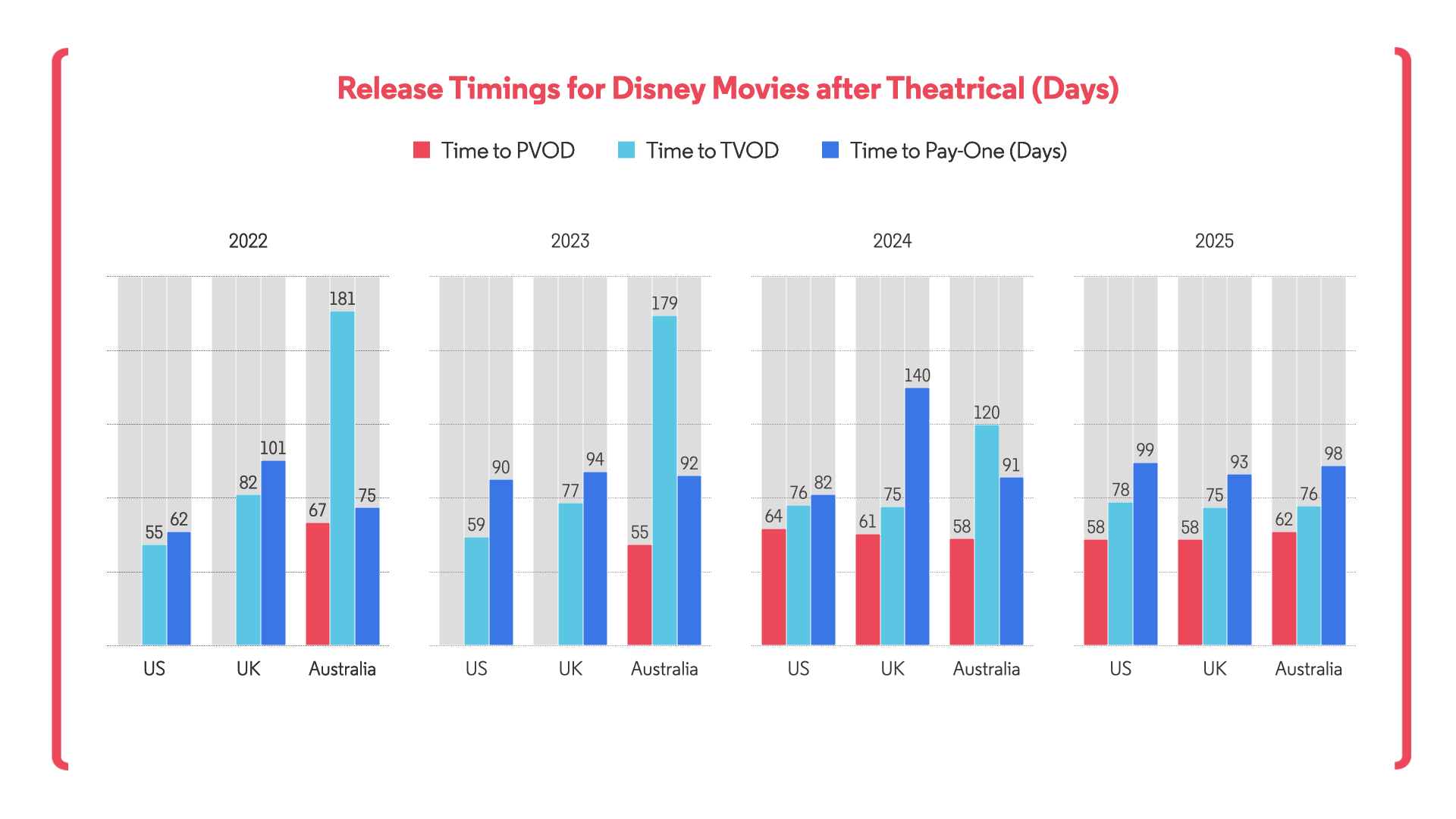
Disney was an early mover in premium digital access during COVID, but in a way that differed from the wider PVOD market. Rather than using premium rental and purchase windows as a standard post-theatrical route, the studio experimented with Disney+ Premier Access, making selected titles available inside Disney+ at an additional charge. This briefly positioned premium access as part of the Disney+ ecosystem itself, rather than as a separate home-entertainment window.
After that period, Disney pulled back from PVOD in the US and UK. Across 2022 and 2023, Disney titles in both markets generally moved straight into regular TVOD and then Disney+, without a meaningful PVOD phase. The US saw TVOD windows of 55 days in 2022 and 59 days in 2023, with Pay-One at 62 and 90 days respectively. The UK followed a slightly longer but similar shape, with TVOD at 82 days in 2022 and 77 days in 2023, before Disney+ at 101 and 94 days.
This reflected Disney’s wider strategic priority at the time. With Disney+ still building scale, the subscription premiere was the central window. The studio was less focused on maximising a premium transactional phase and more focused on using its theatrical slate to feed Disney+ with high-profile exclusive content.
Australia was the main exception. In this market, Disney continued to use PVOD earlier and more consistently, with PVOD windows of 67 days in 2022 and 55 days in 2023. However, this did not translate into earlier regular TVOD access. Instead, Australia’s standard TVOD window sat much later, at 181 days in 2022 and 179 days in 2023, arriving well after the Disney+ window. This suggests a different market approach, where premium access was made available first, Disney+ followed, and regular-price digital rental and purchase was held back for a later stage.
By 2024, Disney’s strategy shifted again. The studio returned to PVOD in the US and UK, but not at the shorter 45-day window that has often become the industry benchmark. Instead, Disney pushed the PVOD window further out, averaging 64 days in the US, 61 days in the UK and 58 days in Australia. This marked a more deliberate re-entry into PVOD: Disney was not simply adopting the faster premium digital strategy used by some competitors, but creating a longer theatrical runway before opening up premium home entertainment.
That pattern continued into 2025. PVOD windows remained close across all three markets, at 58 days in both the US and UK, and 62 days in Australia. Regular TVOD followed a few weeks later, at 78 days in the US, 75 days in the UK and 76 days in Australia. Disney+ then arrived at 99 days in the US, 93 days in the UK and 98 days in Australia.
The result is a much more consistent international framework than Disney had in the earlier years of streaming. In 2025, the gap between the US, UK and Australia is relatively narrow across all three major windows. PVOD sits around two months after theatrical release, regular TVOD follows around two to three weeks later, and Disney+ arrives at roughly three months.
This consistency reflects the maturity of Disney+ across international markets. Unlike the early phase, when Disney was still establishing the service and testing different release models, the platform now has a stronger foothold in each of these territories. That gives Disney more freedom to apply a similar windowing structure across markets where Disney+ is available.
The clearest change is that Disney has moved away from treating Disney+ as a replacement for transactional windows. Instead, the studio now appears to be using each stage more sequentially: protect theatrical first, open a later PVOD window, move into regular TVOD shortly afterwards, then bring titles to Disney+ once the premium and standard digital phases have had room to operate.
Disney’s current strategy is therefore less aggressive than the immediate post-COVID streaming push, but more structured than the experimental period that followed. Disney+ remains the key destination, but it is no longer the only window being prioritised. The studio has settled into a model that gives theatrical, PVOD, TVOD and Disney+ clearer roles - and, increasingly, applies that model consistently across its major international markets.






.jpg)


.svg)


