




Sony began 2026 with a major announcement: a global Pay-One deal with Netflix. The agreement will roll out step by step and include all markets by 2029. It’s already changing which platforms get access to Sony’s movies first.
Movie Tracker shows the buyers that are being replaced. These include long-time Pay TV partners like Sky in the UK, Movistar in Spain, and Canal+ in France, along with regional streaming service Viaplay in the Nordics. So many local operators losing Sony from their own movie proposition further adds a challenge for services that have already had to content with many US studios ending deals in previous years to prioritise their own services instead.
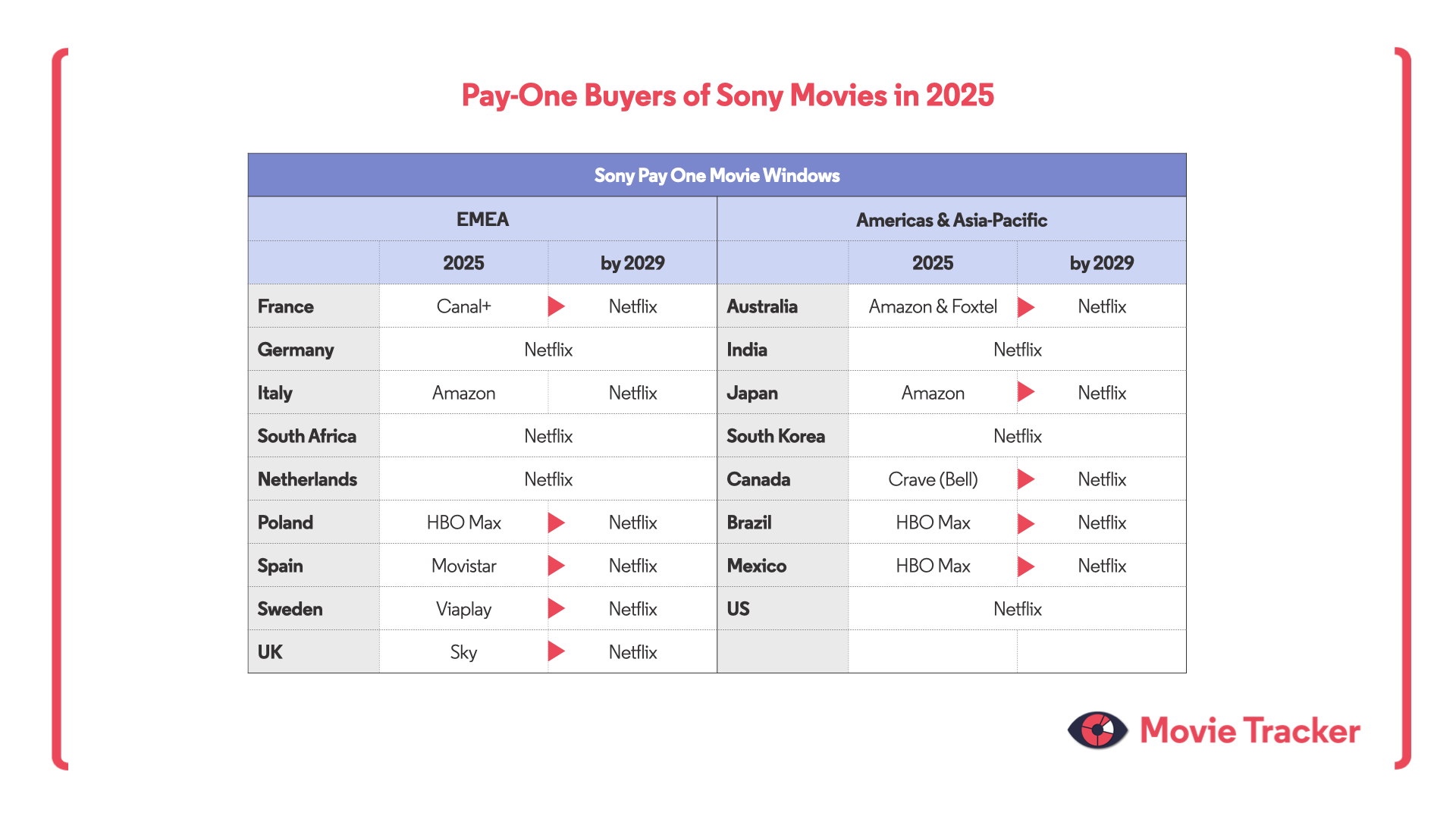
In some countries, the change has already happened. Netflix replaced Sky in Germany in 2023, Multichoice in South Africa in 2020, and Amazon in India in 2021. In Japan, the situation is more complex. Netflix took over from long-term partner Wowow in 2021, but was then replaced by Amazon in 2025. Under the new deal, Netflix will return as Sony’s Pay-One partner in Japan.
France presents the biggest challenge. Current regulations do not allow movies to appear on streaming platforms until 15 months after they are shown in cinemas. These rules could change in 2026. Disney has already secured a special deal: its movies still premiere on Canal+, but are now allowed to appear on Disney+ much sooner than before. Sony may follow Disney’s example if broader changes for all studios aren’t announced.
Where Netflix already has the Pay-One window, Sony does not use a single approach for the next stage. In Germany, Sky usually follows Netflix, with some space for ProSieben. In India, Sony licenses to its own streaming platform, SonyLIV, after Netflix. In the Netherlands, several services follow Netflix, including Amazon, HBO Max, and Viaplay. In South Africa, Multichoice takes titles after Netflix. In the US, Sony movies go to Hulu after Netflix.
These examples from Germany and South Africa present a potential path for current Pay-One holders. If they are open to it, they could continue working with Sony by becoming the second-window destination - just as Sky and Multichoice have done.
In a market where most US studios license to their own streaming platforms for Pay-One, Sony’s independent approach gave local platforms a better chance to license popular films. But the new global deal with Netflix changes that. Local buyers will now have to wait longer - and face more competition - to access Sony content. As this new deal continues to roll out, it will become even more important to track how studios handle licensing after the Pay-One window.










.svg)


